Monday, April 18, 2011

Final Blog Post: April 10 to April 18, 2011

Despite assurances from Iraqi officials that their security forces didn't open fire on citizens of Iranian exile Camp Ashraf last week, the United Nations made an official statement confirming that Iraqi security forces did in fact attack. The U.N. released a death count of 34. The after effects of this are not clear yet.

Tensions between Syria and Iraq rose a bit on Sunday when Syrian border officials found a cache of weapons in the back of an Iraqi vehicle. The weapons ranged from small arms to bombs and also included night vision equipment. The intent of the man driving the vehicle is not known yet.

The weekend brought on a huge amount of violence, culminating on Monday. Protests on Sunday in Sulaimaniya took a nasty turn when things got violent. Angry protesters threw rocks at riot police, who in turn fought back. Later on Sunday, protesters blocked streets and lit tires on fire. Riot police ended up using tear gas and live ammunition to clear the crowds so they could clear up streets again. Some of the protesters were hit in the legs by bullets, but none were killed. There were around 50 total injured on Sunday.

Suicide car bomb wreckage outside the Green Zone.
Monday brought more violence to Iraq. There was similar violence in Sulaimaniya as the previous day. Protesters became violent and again threw rocks at riot police. When the crowd tried to move to another location, the riot police blocked their way. More fighting ensued, which ended up with more tear gas and non-lethal shots fired. Again, nobody was killed but there were around 16 wounded. There were almost 100 people injured in the riots on Monday alone, with 2/3 of them being riot police.

Besides the violent protests, the new week started off with suicide bombings outside Baghdad's Green Zone. Two suicide car bombs were detonated in succession near a military convoy that was headed to the entrance checkpoint at around 8:00 a.m. local time. There are reportedly at least 5 killed and 20 wounded from the explosions.

Sunday, April 10, 2011

Blog Post 9: Iraq April 2nd to April 10, 2011

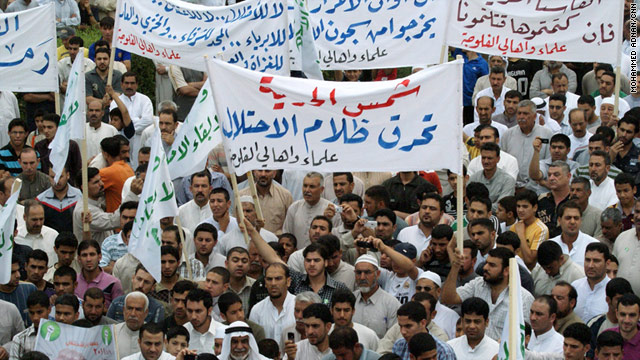
Protesters in Tahrir Square
It has already been 8 years since the fall of Saddam Hussein's regime. The anniversary, however, hasn't stopped protesters from occupying Tahrir Square on Friday to make statements about education, health care and corruption. When Hussein was captured and power was handed back to the people, the leaders promised for better schools and less corruption. With 8 years passing, over 50% of the population belonging to the youth, and less than 40% of those youth enrolled in school, the promises weren't exactly held up like promised. This has been some of the main inspiration for protesters to get out into the square. Protesters have also been demanding the immediate withdrawal of US troops.

An injured Iranian from Camp Ashraf
The Iraqi Army has been busy lately, too. The forces attacked Camp Ashraf, an Iranian dissident camp about 100 km north of Baghdad. The camp has around 3,500 inhabitants and is the base for the People's Mujahideen Organization of Iran, or the PMOI. The PMOI is an opposition group to the Shia Muslim rulers in Iran. Iran, Iraq and the US all consider the PMOI to be a terrorist group. There have been over 30 people killed, including women, and at least 320 wounded.


The attack has made some tension between Iraq and the US, as Defense Secretary Robert Gates was visiting the country and urging Iraq to not use force against the camp. The camp comes into question because the residents of Camp Ashraf technically fall under Iraqi law. The UN and the State department have "condemned the attack" and have tried to provide aid for the camp. But, they have been denied access by Iraq.

Monday, April 4, 2011

Blog Post 8: Iraq March 26th, 2011 to April 1st, 2011

Iraqi guards outside the Technical Institute
The last week of March was filled with violence all over Iraq. Gunmen set off bombs and raided jewelry stores in Baghdad on the 28th. The gunmen set off the bombs to distract police so they could have a more open opportunity at the jewelry stores. There were four killed and nine injured. Besides these raids, there was a roadside bomb that killed one officer and wounded four others. There were four explosions elsewhere in Baghdad, which wounded 12. Three gunmen raided a house in Mosul and killed its seven inhabitants. Finally, six were injured at the Technical Institute in Kirkuk. In these instances alone, there were 12 killed and 31 injured.

There was another assault in Saddam Hussein's hometown of Tikrit on Tuesday the 29th. The gunmen wore police uniforms and suicide vests and assaulted the provincial council office, taking some hostages. The situation intensified to the point where US troops intervened. US troops didn't take back the office, but observed local forces doing so. Tikrit officials said there all the gunmen and hostages were killed, making the death toll about 30.

Azzaman News reported that an explosive device was attached to the car of the Dean of Baghdad University Medical College. Although the killings lately have been with silenced weapons and targeting army officers, professors have also been targeted in the last few years. Because of this, thousands of professors have fled Iraq for fear of their lives.

Friday, March 25, 2011

Blog Post 7: Iraq March 19th, 2011 to March 25th, 2011

News of the protests in Iraq has resurfaced in the wake of the Japan disaster. First, Azzaman News reports that the city of Falluja was given a curfew on the 19th. The curfew was a response to anti-government demonstrations against security officials and U.S. troops, such as bombings of three houses of police officers and a roadside bombing against a U.S. convoy. Some of the local neighborhoods were cordoned off and there were several arrests.

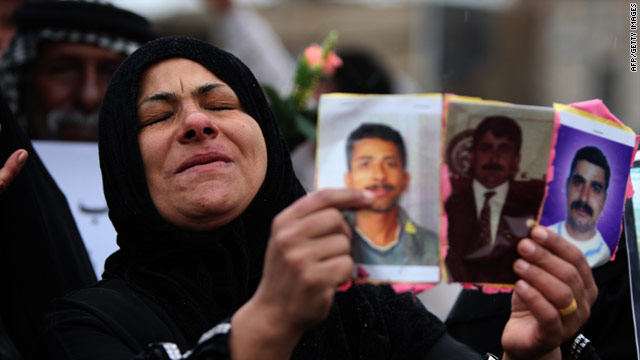
A woman protester demanding the release of her family
CNN posted an update on the protests on the 25th. People continued their protests on corruption, unemployment, treatment of prisoners, and basic services in the rain in Tahrir Square. There were even women there that were demanding the release of their loved ones, who have been held for months without charges. Protest fever has even infiltrated the prisons, too. There was another prison riot on the 24th, this time in Rasafa Prison in Baghdad. Tents were burned and there was fighting until prison guards had to use lethal force to quash the riot, wounding 15.

Senior security officers were targeted this week by gunmen armed with silenced weapons. Sources within the Interior Ministry said that there were at least eight killed in three days. Among those killed were a Lieutenant General, a Major General, a Major and a Captain. All these officers were ranking members of the Iraqi Army. These assassinations have vacated the positions of Minister of Interior, Minister of Defense and Minister of National Security. Prime Minister Maliki has yet to fill these positions.

Friday, March 18, 2011

Blog Post 6: Iraq March 12th, 2011 to March 18th, 2011

Global news of the past week has focused primarily on the tragedies of Japan, and with good reason. However, the rest of the world moves on and Iraq is no exception. There has been little news about the protests for political reform across the country, but it seems like some of the protesters have shifted their attention to Bahrain. The Xinhua News Agency reported that demonstrators in cities across Iraq have been calling for support of the people in Bahrain and that the Iraqi Parliament will back them up.

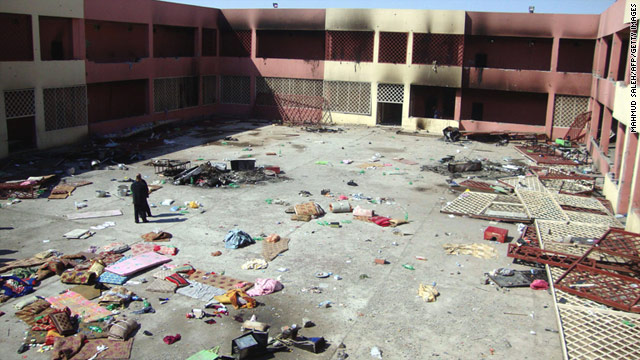
The aftermath of the prison riot
CNN reports that there was a small riot at a prison in Tikrit on Sunday the 13th. Reports tell that the fires and rioting were instigated by al Qaeda prisoners trying to protest poor living conditions and corruption in the prison. There were at least 2 killed and 14 injured, including a mix of prisoners and guards. The following day, a suicide bomber detonated a vehicle born improvised explosive device (VBIED) outside military headquarters in a town 40 miles northeast of Baghdad. The attack killed 11 and injured at least 30.

Digging back a couple weeks, I found an interview with the former Iraqi Prime Minister. Iyad Allawi served as the interim Prime Minister from June 2004 to April of 2005. I found the interview on Al Jazeera and some of his responses are really interesting. He comments on the protests in Iraq and how he thinks they will impact the government. He makes the bold statement of saying that there isn't really democracy in Iraq. Keeping in mind the protests of the last couple months, I would say that there isn't a perfect democracy in place and that's why there are protests. It's going to be interesting to see where the protests end up leading and whether Allawi will change his view on the level of democracy in Iraq.


The original video with text can be viewed here

Friday, March 11, 2011

Blog Post 5: Iraq March 5th, 2011 to March 11, 2011

Guards outside of the offices of the Iraqi Nation Party
The protests in Iraq the last couple weeks are still going on, despite the efforts of Prime Minister Nuri Kamal al-Maliki. The International Herald Tribune reports that Maliki has ordered the closing of the offices of two leading political parties organizing demonstrations. The two parties, the Iraqi Nation Party and the Iraqi Communist Party, were approached on the morning of the 7th by armed security forces bearing the message to close their offices. The parties are calling it a breach of democracy while Maliki's office states that it's simply part of a project to return use of public buildings back to the government.

The violence in Iraq seems to be never ceasing, too. A group of armed gunmen tried to rob a jewelry store in Baghdad on the 10th. They were interrupted by police and began exchanging fire. The gunmen escaped leaving 6 dead. Al Jazeera reports that an Iraqi general was killed in an unrelated incident in Baghdad in a roadside bombing on Wednesday. Brigadier-General Taha Ahmed Samir, head of training for Iraq's air force, was killed along with two other soldiers in the convoy.

The mosque recently reopened in Samarra
A small beacon of hope and achievement for Iraq shines out of the city of Samarra. A mosque, destroyed by insurgents about five years ago, has recently finished reconstruction and is open again to worship. The mosque contains one of the most holy relics to the Shiites: the Askariya Shrine. The shring was built in 944 AD and is an icon for Shiites across the Middle East and even for the Sunnis living in Samaraa. The rebuilding of the mosque is seen as movement forward in Samarra.

This week has some tell-tale examples of how things have been going for Iraq the last couple decades. There has been struggle, violence, rebuilding and reconstruction only to fall back into the same cycle. There is some controversy over whether or not Maliki is shutting down the offices of the two parties as a way to stifle the protests and if how he did it is legal. On the contrary, this could inspire the people more to protest and maybe eventually oust Maliki from his office.

Friday, March 4, 2011

Blog Post 4: Iraq February 26th through March 4th, 2011

As is the trend in the Middle East lately, protests dominate the headlines of Iraq. On Friday, protesters flooded Tahrir Square in Baghdad to continue the protests on unemployment and corruption. Prime Minister Nuri Kamal al-Maliki issued a vehicle ban on the city that forced the protesters to walk to the square. In an act of determination, they walked for hours from all over to protest.

Security forces in Iraq
Concerns have risen about how much power Prime Minister Maliki has, too. Spirited by the Middle Eastern protests, scrutiny about Maliki's amount of power has surfaced. In January, a ruling by Iraq's high court gave Maliki authority over previously independent agencies that run the country's central bank, elections, and corruption investigation. A month after this ruling, two human rights groups reported that Maliki was directly in charge of forces that run secret prisons that torture their inmates. Last July, the high court took away legislation proposition from Parliament and gave it to Maliki's cabinet and the president. These rulings are sure to fuel the protests in Iraq even more, maybe even calling for Maliki to step down.

The protests this week follow in the shadow of the biggest rally so far, which happened last Friday (February 25th). The protests have had been a mix of violence and peace, like last Friday's protest, which yielded 16 dead and over 130 wounded. However, Iraqi protesters are trying to make them as peaceful as possible. Kamil al-Assadi of Sadr City formed a committee to check the protesters entering the city for possible weapons. He said that he wants to prevent security forces from planting violent protesters in the crowd.

Seeing this brings hope for the protests in Iraq. While it is bound to be a long process, it's good to see that there are people trying to make it as safe as it can be and not give security forces a reason to open fire on the crowds. But, change is not impossible, as shown by other countries in the region.

Friday, February 25, 2011

Blog Post 3: Iraq February 19th through February 25th, 2011

The main story of the last week is protests, protests, protests. The entire Middle East has erupted into protests, not to exclude Iraq. The protests centered around social reform, new jobs and direct supervision to try and reduce corruption in the government.
Iraqi Prime Minister Nuri Kamal al-Maliki made a statement on the night of Thursday, February 24th urging protestors not to take to the streets on Friday. He claimed that insurgent groups, such as the Al Qaeda and remnants from Saddam Hussein's Baath party were going to try and bring terror and chaos to the protests.

Map of the Green Zone from CNN on globalsecurity.org 
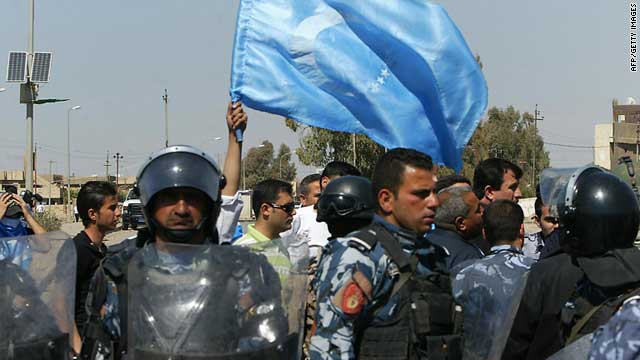
The protesters waived off the Prime Minister's warning as a scare tactic and took to the streets on Friday anyways. Thousands of protesters flooded the streets and things soon became violent. People threw rocks, got into scuffles with security forces, and protestors in Baghdad even pulled down barriers blocking the bridge to the Green Zone. The Green Zone is a cordoned off area of Baghdad where US authorities live and work.

Riot Police guarding the Green Zone
These protests in Iraq quickly turned violent on Friday, forcing security forces and the Iraqi Army to resort to using lethal force. There are reports of forces opening fire on groups of protesters all over Iraq in places like Baghdad, Hawija, Salahuddin, and Mosul. It's not clear how many have been killed and injured so far. Articles from the International Herald Tribune and Al Jazeera give a more detailed look at the protests.


Tunisia really sparked a sort of "Middle Eastern Revolution" that has people demanding more from their government. The protests in Iraq are slightly different than those in other countries, though. Iraqi protesters are calling for better services from and reforms in their government instead of dismantling it and starting over. This shows that while the government the US helped set up in Iraq is weak and needs to be adapted, the people have generally taken to it. They accept the democracy we tried setting up there and are now exercising their rights within that democracy. The use of lethal force is a little nerve racking, but if the protests calm down a bit and use peace instead of violence, I think they can get big changes to happen.

Monday, February 21, 2011

Blog Post 2: Iraq February 12th through February 18th, 2011

Iraq has joined in the middle eastern wave of protests that was sparked by Tunisia and Egypt in the past couple months. People took to the streets all over Iraq to protest different things. In Basra, protests favored better services and jobs from the government. Protests in the Kurdish region in northern Iraq appear to be a response to an attack on the Kurdistan Democratic Party offices the day prior. Reports show that one person was killed and 47 were injured in these protests.
Protests!!!


Protests in Baghdad and Kut turned violent when security forces opened fire on a group of protesters calling for the resignation of their provincial governor and at least 3 were killed. The shooting spurred protesters to storm and burn the governor's office and home. They burned all the rooms and even the employees cars. At least 27 people were injured in the storming of the governor's office and home.


There is a glimmer of progress in Iraq through the smoke of these recent protests. In an effort to help provide Iraq with the right amount of electricity, a contract has been made with the Korean Hyundai company to build a 500 megawatt power plant. This power plant, as well as the 1,250 megawatt power plant being built in the Karbala Province, will help close in on the needed amount of electricity to power the country. The Ministry of Electricity expects that the national grid will be able to meet the needs within 2 years.


Iraq continues it's ceaseless cycle of moving forward and then backwards. While protests are not bad in every respect, violent protests are not the way to go. Police violence to protests will do more harm than good.  One person in Iraq said, “When they opened fire on us, I was feeling that we are not a free country.” These feelings will lead to more violence, moving Iraq even more backwards. 

Thursday, February 10, 2011

Blog Post 1: Iraq February 4th through February 11th, 2011

Much has happened in Iraq in the past week, but some things stand out more than others.

A Turkish firm has made plans to construct a power plan in the Karbala Province. The project is going to cost about $450 million and will generate 1,250 megawatts. The plant will create as many as 500 new jobs and is expected to be completed within 2 years. The power plant will provide more than double the amount of electricity that the region needs and will export the surplus to its surrounding provinces. Further information can be found here.

There has also been buzz surrounding a display of mannequins in northern Baghdad. The mannequins are dressed, according to Muslim standards, rather scandalously. There is blond hair showing beneath scarves, skin exposed that usually isn't, and other things of the sort. What's causing the buzz is that the mannequins are standing before a fiery backdrop with a message that says "Whoever fills his eyes with the forbidden, on judgment day God will fill them with fire." This entire display is a blunt reminder that if women don't dress according to their religion, they and the men that look at them will be punished by God. Read the full article here.

Wreckage at Kirkuk
The usual Thursday morning bustle in the towns of Kirkuk and Dujail was broken by a series of car bombings. Dujail is about 50 km north of Baghdad while Kirkuk is about 240 km north of Baghdad. In total, there are an estimated 15 killed and as many as 50 injured from the bombings. Terrorist organizations are suspected to be behind the incidences. Here are the links for both articles: Dujail and Kirkuk.


The events this week show to me the struggle still going on in Iraq between moving forward and keeping to well established roots. The construction of a huge power plant is a great way to make jobs and supply necessary electricity. At the same time, heritage, traditions and religion still play a large part of society, such as women remaining covered for fear of God. Then, the constant reminder of terrorist organizations' plots to disrupt what they can is ever present. I would personally not be surprised if the building of the power plant is slowed due to attempted bombings.